Nobody writes the answer down on a Tuesday
On Tuesday a buyer tells a salesperson that the price worries her and that she already uses a competitor. On Thursday a different salesperson hears the same 2 worries from someone else.
Nobody wrote down a good answer, because writing it down is a Friday afternoon job, and Friday afternoon already belongs to pipeline panic.
What it does
- It takes a sales call recorded in Granola (a meeting notetaker) or a written transcript from anywhere else.
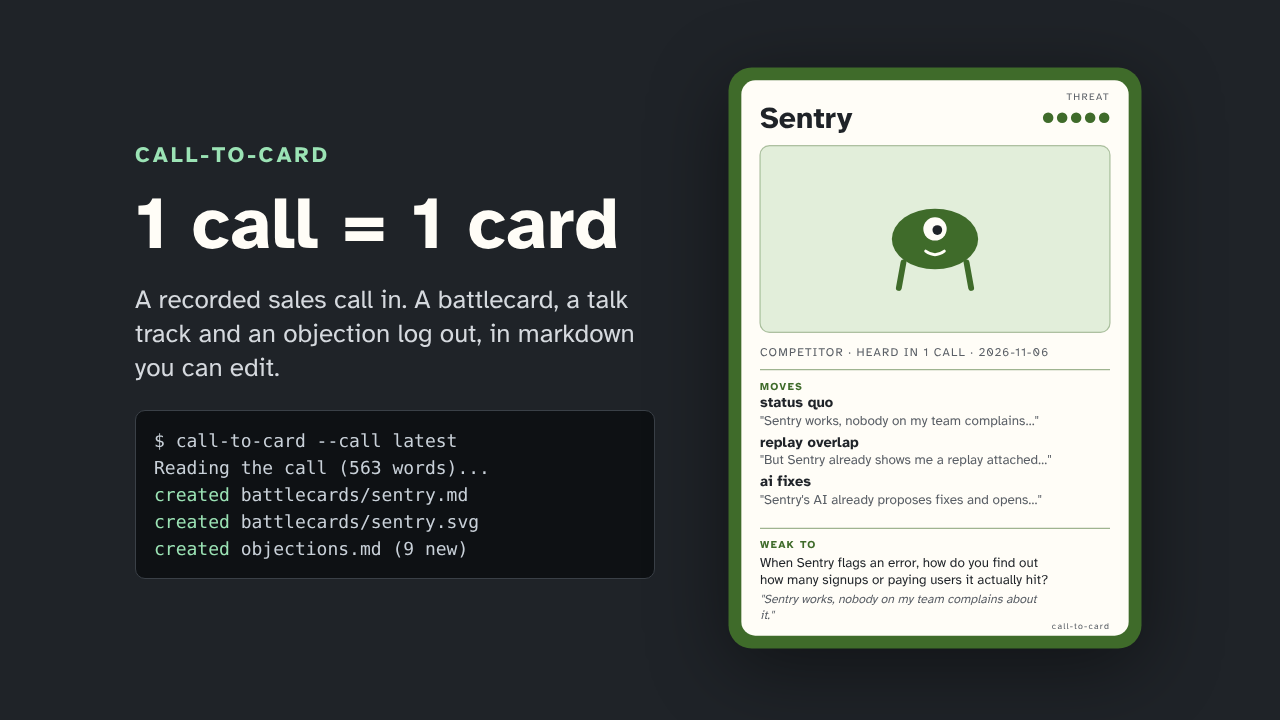
- It writes a battlecard for the competitor the buyer named. A battlecard is the one-page cheat sheet a salesperson uses when a buyer brings up a competitor. It also writes a talk track, which is an opening and a set of questions for that kind of call.
- It keeps a log of every objection, meaning every reason a buyer gave for hesitating, and counts how often each one comes up.
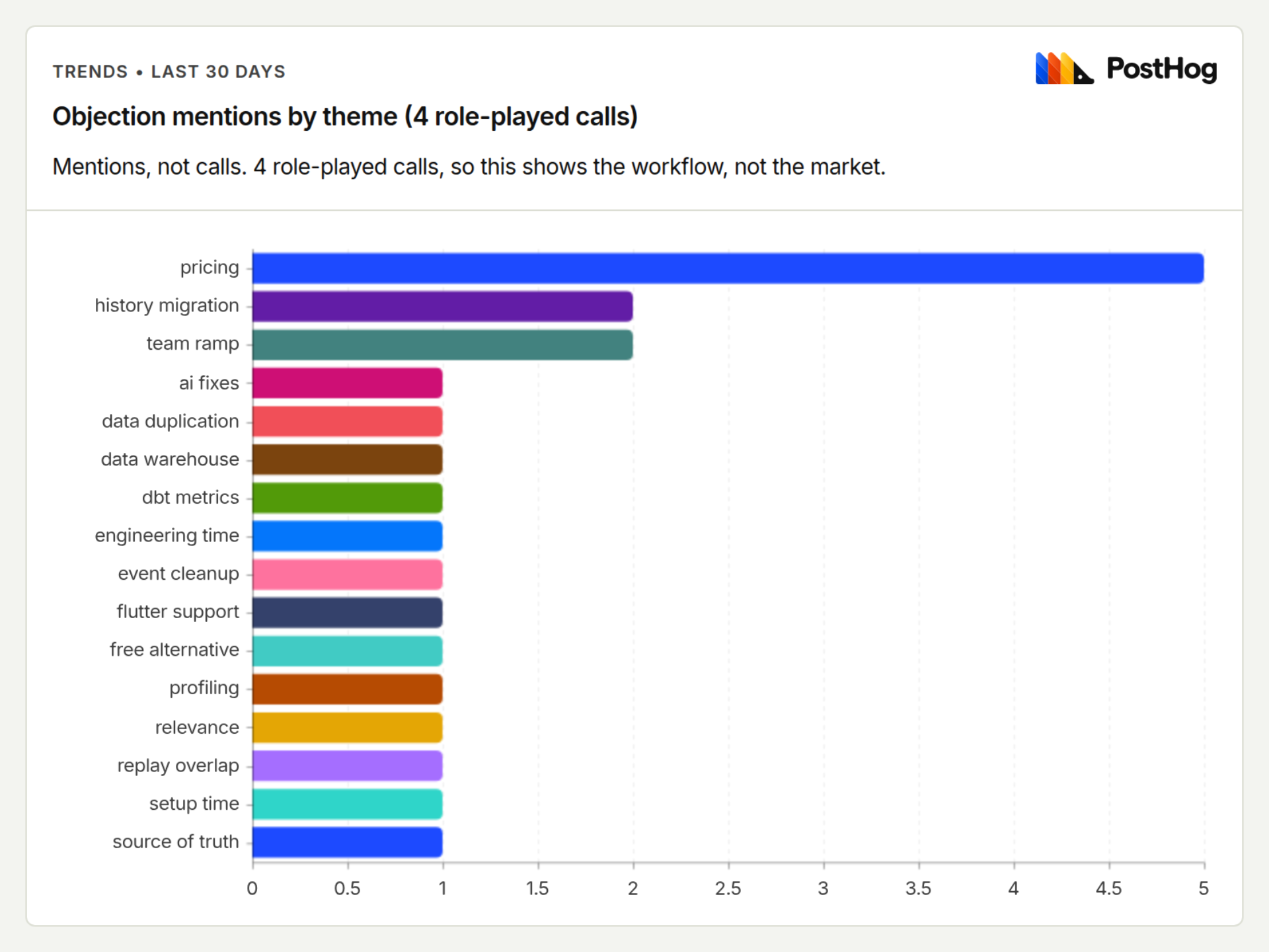
- It sends each objection to PostHog, a product analytics tool, so the log is also a chart.
- A person finishes the job by fixing what the model got wrong.
I used PostHog as the example company because its sales handbook and competitor pages are public, so I could check every answer against a page. The 4 example calls are role-played with a scripted buyer, so they test the workflow and say nothing about the market.
How it's built
- It is written in TypeScript and runs as one command.
- It reads calls from Granola through MCP, a standard way for AI tools to reach other apps. It can also read a transcript file.
- The instructions to the model live in the repository as a plain file, now on a third version. I revised it each time after reading what the last version got wrong.
- Running the same call twice never double-counts it, and the tool never overwrites edits a person made.
- The transcript goes to the Claude API to write the drafts. PostHog receives the theme of each objection, the competitor's name and the date. It never receives the buyer's words.
4 judgment calls the model got wrong
The first drafts read well and were wrong in ways that would embarrass a salesperson. The repository keeps the model's raw output and my edits separately, so anyone can see what I changed.
Saying it on a call doesn't make it true
The first version treated the salesperson's own claims as proof. Now only facts the buyer gave count as evidence.
Cut what nobody said
On a call about Sentry, an error-tracking tool, the draft said Sentry's AI fixes were better than PostHog's. It also said PostHog supported Flutter, a mobile app framework. Nobody on the call said either. I replaced both with a line a salesperson can say safely: I will confirm it in writing today.
Count mentions and count buyers
Pricing came up 5 times, in 3 of the 4 calls. The log shows both numbers, because 1 loud buyer is a different problem from 3 buyers.
A tool the buyer already uses is not a rival
The model treated every product mentioned like an enemy combatant. One team just used Snowflake to store data and wanted to know how PostHog fit into the stack, but the model was already preparing to go to war with a data warehouse. That call now gets a quiet talk track and zero combat.
What I'd change about PostHog's pitch
Writing the Sentry card meant reading how PostHog sells against Sentry. This is what I found on November 6, 2026.
I'd keep PostHog's context-layer positioning, but make the competitive pitch more specific. The observability selling guide still leans on replay as a distinction from Sentry and leaves its Sentry/Datadog battlecard "To be added", although PostHog's own comparison acknowledges that Sentry has replay.
For a team already on PostHog, I'd lead with whether connecting errors to the product behavior they already measure helps them decide what to fix. Then I'd show the workflow, the extra cost, and the cases where keeping Sentry is the better decision. The Sentry card is my first pass at that conversation, using a role-played call to test the draft.
The question buyers ask before the pitch starts
After the build I asked someone who works with customers what salespeople run out of time for. Buyers arrive with a set agenda and still ask what companies like theirs track. The call rarely has room for the answer.
So the next feature is a short "what teams like yours ask about" section, built from the industry of each logged call. The salesperson sends it before the call, and marketing gets a list of questions worth answering in public.
I built this in about 4 hours
I'm a marketer who spent 6 years on a core development team before deciding the nerdiest form of marketing was my jam, so working in a code repository is familiar ground. I built this with Claude, an AI model, writing code alongside me. I set the scope, wrote and revised the instructions, read every change and edited the output by hand.
I have used AI daily since mid-2023 for research, competitive analysis, go-to-market development and executive communications. This is one recent example, and I kept it to one evening on purpose. With real call recordings and a company's own sales guide to work from, it would go a lot further.